What Is Asian Handicap? A Plain-English Guide for Complete Beginners
If you have never looked at odds before, this article is for you. No jargon, no confusing number tables — just clear explanations and real-life examples.
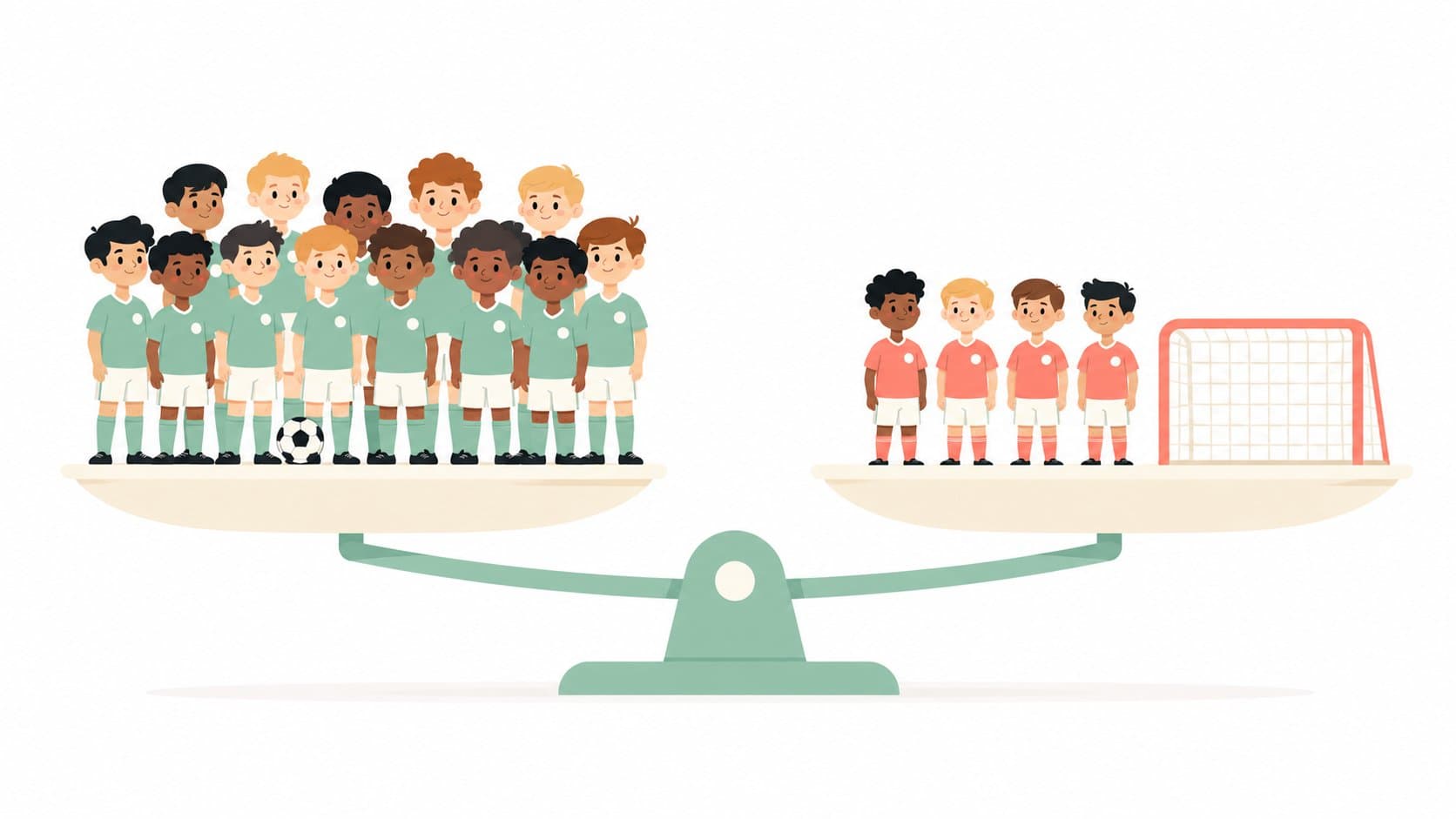
Why does Asian Handicap exist in the first place?
Picture this: Barcelona is playing a small team from the lower divisions. Everyone knows Barcelona is the clear favourite, so the price for a Barcelona win is very low, around 1.05.
The price for the small team, on the other hand, is very high, because its chance of winning is close to zero.
This is where Asian Handicap comes in. It evens out lopsided matches so both sides have prices close to each other.
So what is Asian Handicap, really? (in the simplest possible language)
Asian Handicap is an imaginary head start given to the weaker team before the match begins. Or, looked at from the other side — goals are "taken away" from the stronger team right at kick-off.
That way, the two teams become even on paper, which makes the match interesting.
That's the whole idea. Seriously. Everything else is just details.
Your first example (pay attention — this is where it all clicks)
Barcelona vs. small team. The bookmaker offers you:
"Barcelona -1 goal"
What does that mean? Simple: subtract 1 goal from Barcelona's final score and see what you get.
Three possible scenarios:
| Real Score | After Handicap (-1 for Barça) | What happens to your pick? |
|---|---|---|
| Barcelona 3 - 1 | Barcelona 2 - 1 | ✅ You win |
| Barcelona 2 - 1 | Barcelona 1 - 1 | 🔄 Stake refunded (push) |
| Barcelona 1 - 0 | Barcelona 0 - 0 | 🔄 Stake refunded |
| Small team 1 - 0 | Small team 1 - (-1) | ❌ You lose |
See what happened? When you pick Barcelona -1, they need to win by at least 2 goals to guarantee your win. If they win by exactly 1 goal — you simply get your stake back. No win, no loss.
The three types of handicaps (from easiest to "weirdest")
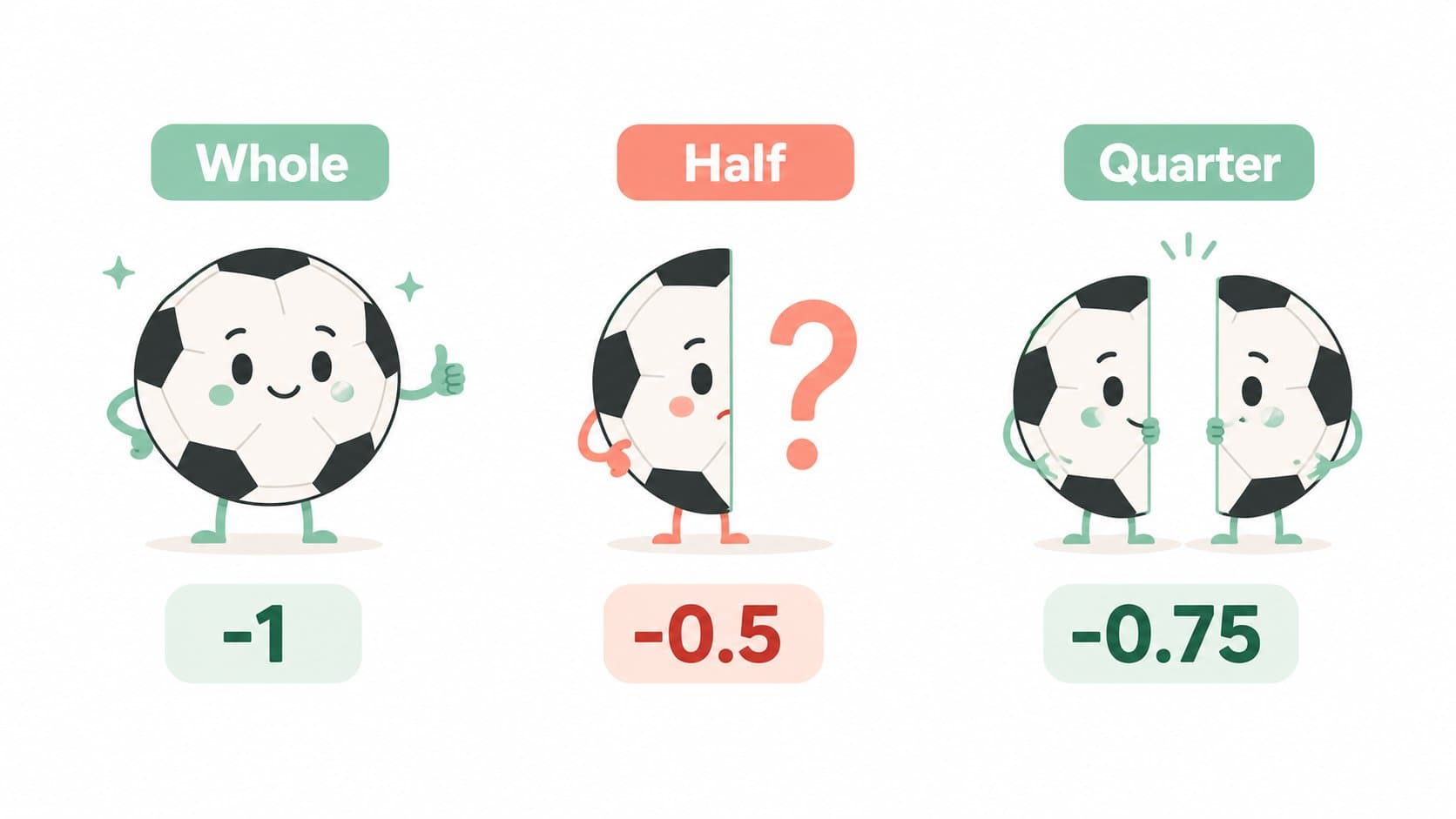
1. Whole Handicaps: -1, -2, +1, +2
These are the easiest. You have three possible outcomes:
- ✅ You win — if your team covers the handicap
- ❌ You lose — if it doesn't
- 🔄 Stake refunded — if it ends in an exact tie after the handicap
2. Half Handicaps: -0.5, -1.5, +0.5, +1.5
Here there's no "stake refunded" option — you either win or lose. Why? Because no team can score "half a goal." 😄
Example: Barcelona -1.5 means Barça must win by at least 2 goals. If they win 1-0 — you lose. If they win 2-0, 3-1, 4-2 — you win.
Simple and clear. No grey area.
3. Quarter Handicaps: -0.25, -0.75, +0.25, +0.75 (this is where the "magic" begins)
This one scares most people, but the idea is elementary:
Your stake is split into two equal halves.
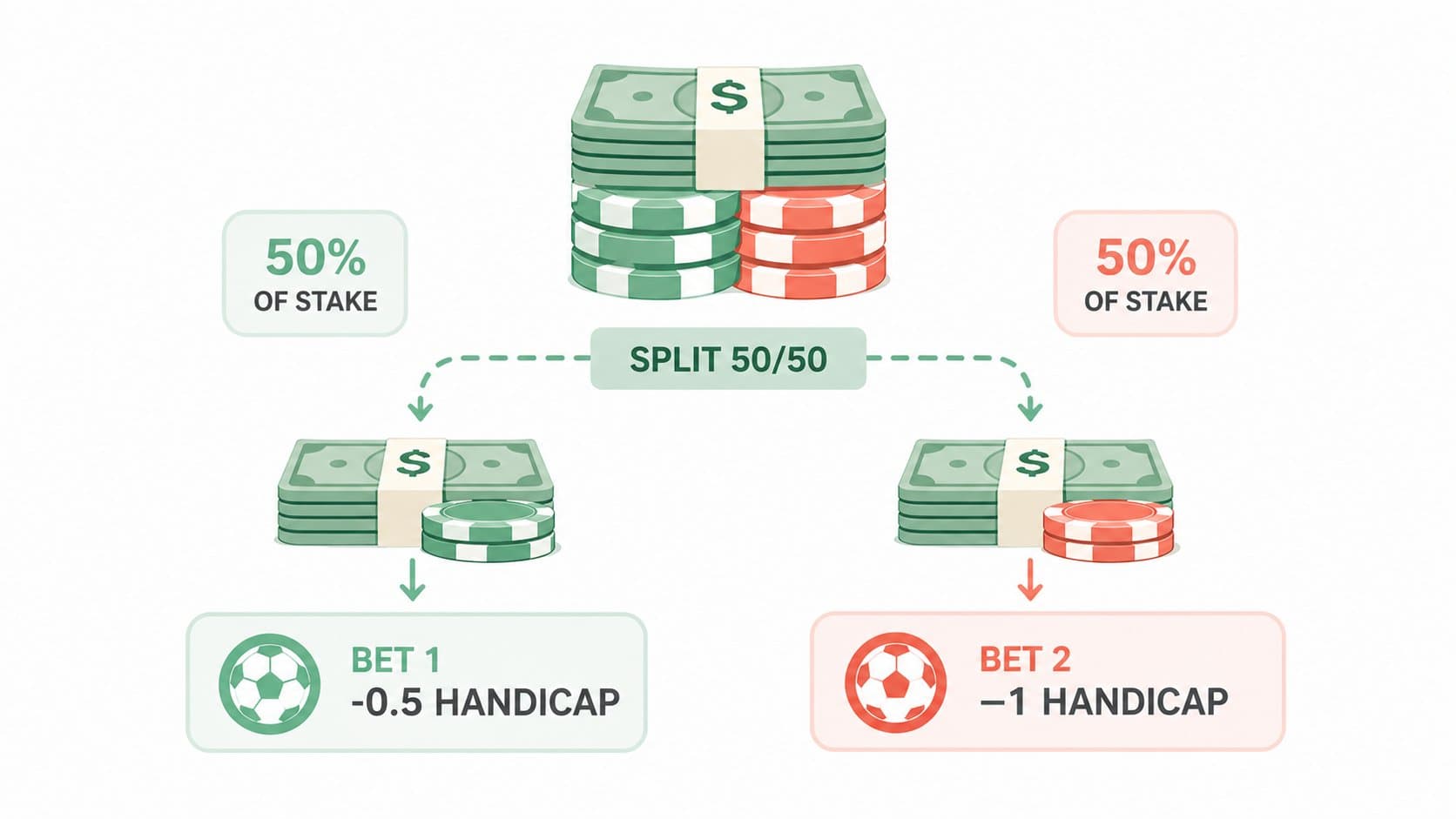
Example: You put €100 on Barcelona -0.75.
In practice, this is two separate picks:
- €50 on Barcelona -0.5
- €50 on Barcelona -1
Each is settled separately and the results are added together.
Scenarios:
- Barça wins by 2+ goals: both halves win → full win
- Barça wins by exactly 1 goal: -0.5 wins (€50 profit), -1 is a push (€50 refunded) → half win
- Barça draws or loses: both halves lose → full loss
It only sounds complicated in writing. In practice, you just receive either half the profit, the full profit, or a partial refund.
How is Asian Handicap different from the regular 1X2?
Four main differences:
1. Different prices. Because "draw" is not a separate option, the prices for each side are higher than in the standard 1X2 market.
2. No "draw" outcome in most cases. Just two possibilities.
3. Refund on a push. With whole handicaps, if the result is level after the handicap, the amount is returned.
4. Lopsided matches. When a top team plays a small team, the handicap brings the two sides' prices close together.
A real-life analogy you'll never forget
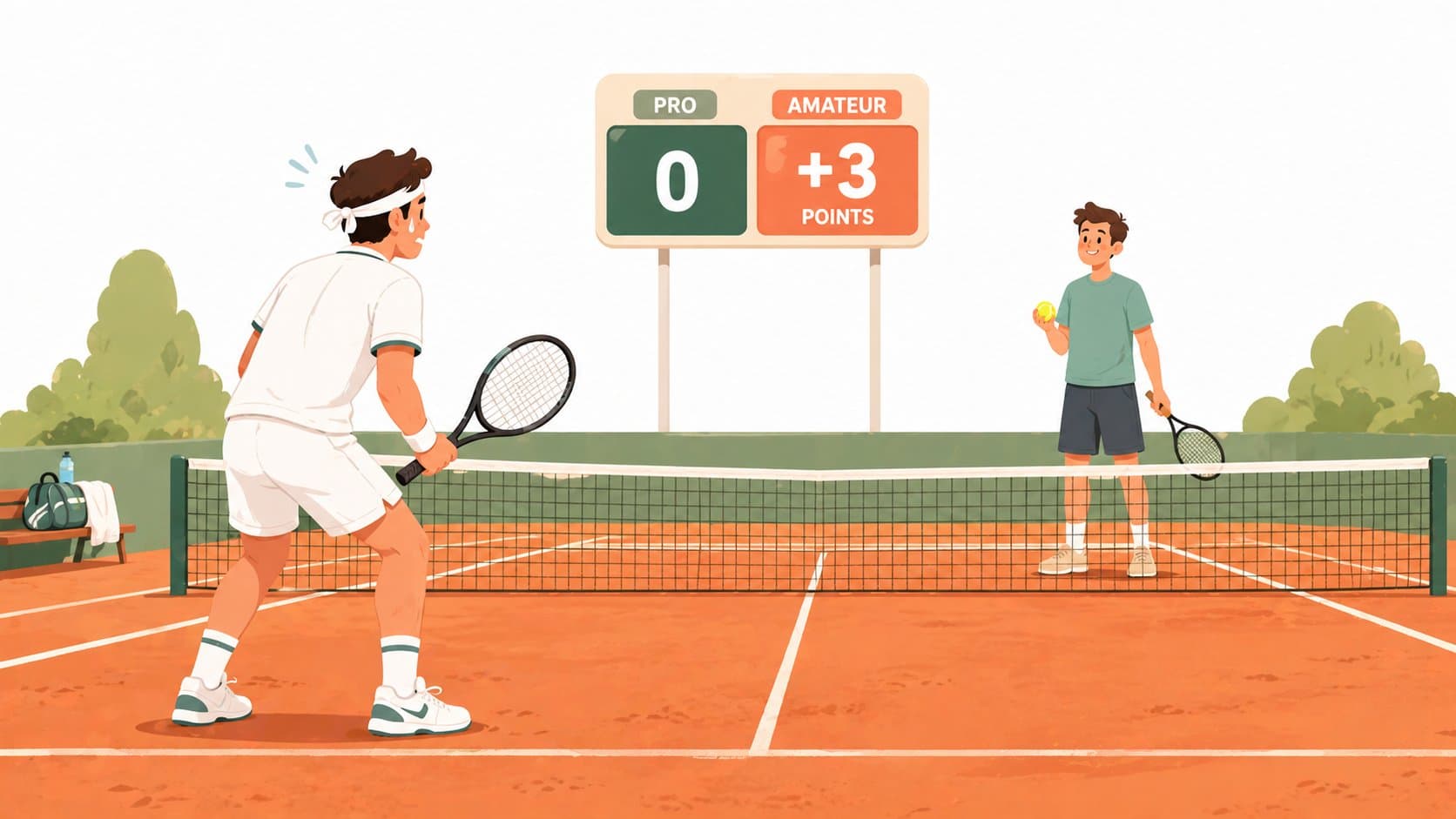
Imagine two friends playing tennis.
- One is a professional with 20 years of experience.
- The other is an amateur who only plays on weekends.
If you ask "who will win" — there's no point. Any sane person knows the answer.
But if you say: "The amateur starts with a 3-point head start" — now it's a real contest! Maybe the amateur holds onto those 3 points. Maybe the pro catches up. Nobody knows for sure.
That's exactly what Asian Handicap does. It turns a predictable match into a real contest.
Quick summary (if you only remember one thing)
- ✏️ Minus (-) before the number = goals are taken away from this team. They're the favorite and need to win convincingly.
- ✏️ Plus (+) before the number = this team gets goals as a head start. They're the underdog being helped out.
- ✏️ Whole numbers (-1, -2, +1, +2) → chance of stake refund if it's tied after the handicap.
- ✏️ Halves (-0.5, +0.5) → either win or lose. No middle ground.
- ✏️ Quarters (-0.25, -0.75) → your stake is split into two separate parts.
A final note
The simplest lines to read are +0.5, -0.5, +1 and -1. Quarter lines combine two of them, so it helps to understand those first.
This guide explains how the lines work. It is information only and is not a recommendation to take any action.
If you gamble: only risk what you are prepared to lose. Gambling is entertainment, not a source of income.